

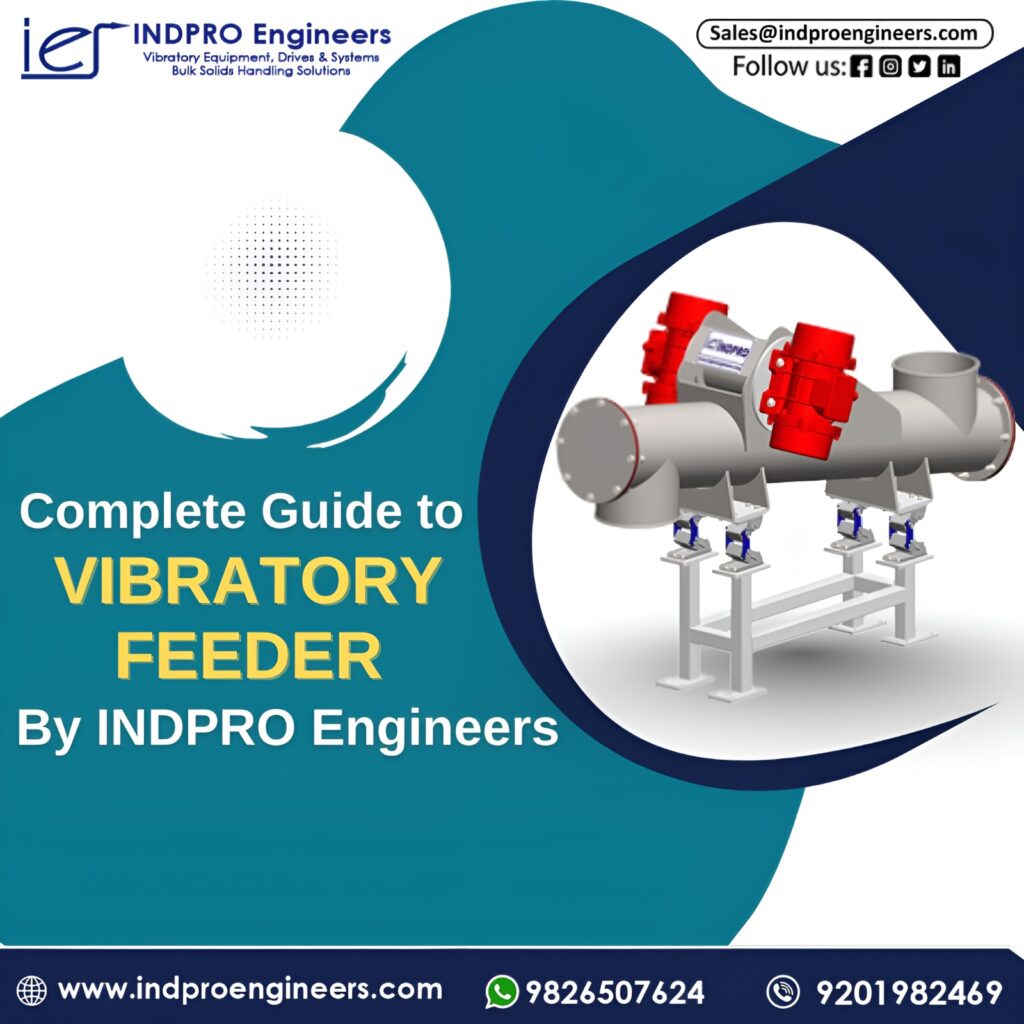
Complete Guide to Vibratory Feeder by Indpro Engineers
- posted by: Indpro Engineers
- No Comments
- Vibratory Feeder
- Edit Text Editor
Common industries with the use of vibratory feeder include the packaging industry, mining industry, food processing industry, chemical industry, pharmaceutical industry, and plastic industry.These industries represent common Vibratory Feeder Applications where controlled and consistent material feeding is required.
Vibratory Feeder do not have belts or rollers as traditional conveyors do. They then vibrate materials along a certain trajectory by creating controlled vibrations instead. This does not only minimize wear and tear but also enables clean, slick, and low-friction material handling.
What’s the Basic Idea Behind Vibratory Feeder Working Principle?
A Vibrator Feeder functions on the basis of regulated vibration.. This tractor is made up of a tray or a tube that is supported by springs and is connected to a vibratory drive (this is typically an electromagnetic or motor-based actuator). Once the system is on, a high back-and-forth movement is created, making the material on it hop or slide on the tray.
How Does the Vibratory Feeder Work?
Loading Material: The feeder tray is loaded with bulk solids (e.g., powders/granules or small parts).
- Vibratory Motion: The feeder vibrates with a limited frequency and amplitude.
- Material Movements: The vibration carries the material at a steady rate and at a steady pace.
- Discharge: The material is discharged into an adjoining piece of equipment ( vibratory conveyor, a vibratory screener, or a packaging machine).
The system provides accurate control, which enables a regular flow of materials even with thin or delicate materials. These controlled feeding characteristics are among the key Vibratory Feeder Benefits for applications that require consistent and accurate material flow.
Types of Vibratory Feeder
Different industries have different requirements, and several types of vibratory Feeder are available to meet specific needs:
- Vibratory Pan Feeder/Conveyor
- Vibratory Tube Feeder/Conveyor
- Vibratory Spiral Elevator
- Vibrating Bin Discharger
- Vibrating Bin Aerator / Vibrating Aerators
- Vibratory Screener
Each type of feeder is tailored to specific material properties, flow rates, and space requirements.
Cost of Vibratory Feeder:
The cost of a vibratory feeder depends upon various factor:
- Feeder type (pan, tube, spiral, etc.)
- The size/capacity
- The material used in construction (e.g., stainless steel to be used with food)
- Kind of vibratory drive (motor-driven vs. electromagnetic)
- Upgrading with customizations (coating, sensors, etc.)
Simple vibratory feeder may be available from 40,000 onwards up to 1 lakh. Higher or customized models of the industry would cost anywhere between 1.5 and 5 lakhs or more.
Although the price may differ, it is always good to make an investment in quality feeder which will be very efficient and reliable in the long run.
Vibratory Feeder Selection Guide
The steps to choosing the correct vibratory feeder are as follows:
Get to Know Your Stuff
Think of flow, size, weight, softness, and moisture.
Determine your Requiresd Flow Rate
Be aware of how many materials you have to travel every hour.
Choose the Type of Feeder
Depending on the application and the space required, use either vibratory pan conveyor, tube feeder, spiral elevator, etc.
Custom Features Scan
On a need-to-have basis, seek features such as variable speed control, being food-grade design, or enclosed systems.
Consult Experts
Team up with manufacturers well versed in this that can advise you on the correct feeder according to your industry and applications.
Best Vibratory Feeder Manufacturing Company India
India has some well-known manufacturers, and one of the names is Indpro Engineers.
With a vast array of special product applications that it offers within several industry segments, Indpro Engineers is one of the leading manufacturers of vibratory feeder in India. They produce all kinds of feeders such as vibratory tube feeder, pan conveyor, spiral elevators etc. They are then strong in:
- Design and engineering in-house
- Sturdy, hard-to-maintain constructions
- Food, pharma, and heavy industry customization
- Technical support and installation service by experts
Indpro Trusted Feeder have been known to be precise in feeding, have long operative lifetimes, and can be easily adapted to most current systems.
Buy Vibratory Feeder from Indpro Engineers at best price
Vibratory feeder is a needed remedy for permanent, smooth, and regulatory material input in any industrial operation. Beyond feeding powders in a pharma unit to transporting aggregates in a foundry, vibratory feeder promise good performance at comparatively low maintenance.
Available in forms such as the vibratory pan conveyor, tube feeders, vibratory spiral elevators, and bin dischargers, the design has a feeder for every application. Selecting a reputable manufacturer such as Indpro Engineers will mean that you not only receive a machine but also a total feeding system to fit your process requirements.
FAQ About Vibratory Feeder
A vibratory feeder is a material handling machine that uses controlled vibration to move and feed bulk materials at a consistent rate. It is commonly used to transfer powders, granules, aggregates, and other solid materials from hoppers or storage units to the next stage of a production process. Vibratory feeders provide controlled material flow, accurate feeding, and continuous operation in various industries.
Vibratory feeders are used to continuously and efficiently feed bulk materials such as powders, granules, pellets, and small components into processing, conveying, or packaging equipment. They are widely used in industries including food, pharmaceuticals, chemicals, plastics, mining, cement, and manufacturing.
Yes. Vibratory feeders can handle a wide range of materials, including powders, granules, pellets, small components, and other bulk solids. The feeder can be designed and adjusted according to the material’s size, weight, flow characteristics, and required feed rate, making it suitable for various industrial applications.